
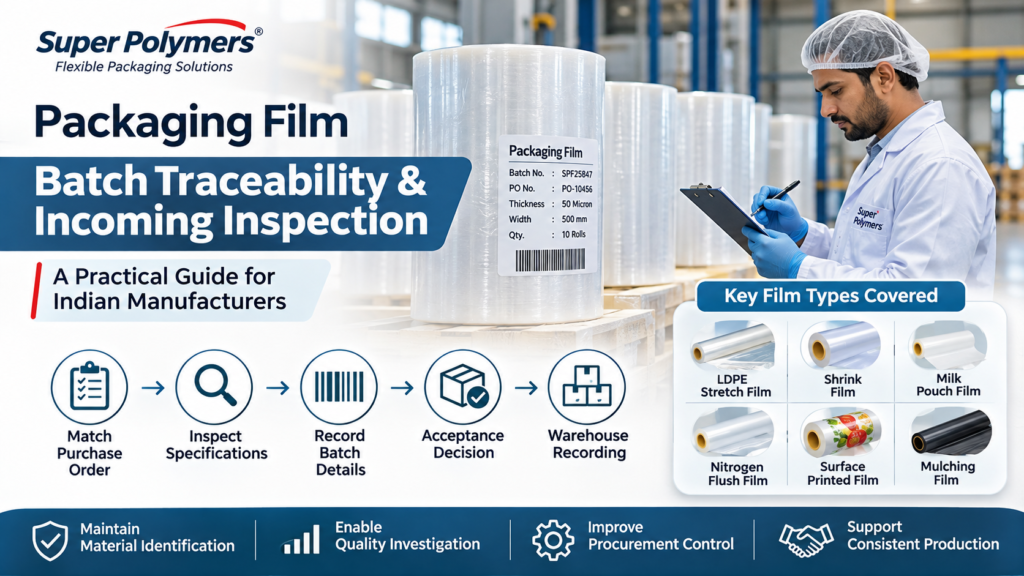
When manufacturers purchase flexible packaging films in bulk, checking the delivered quantity is only one part of the receiving process. They also need to identify the supplied material, verify agreed specifications, maintain delivery records and document quality-related observations. Packaging film batch traceability helps businesses maintain these records and supports a more organised incoming material inspection process.
This is particularly important for Indian manufacturers that receive multiple film types, repeat orders or deliveries from different suppliers. Without organised material identification and inspection records, it can become difficult to connect a production-related concern with the specific material received.
This guide explains how procurement managers, plant heads and quality-control teams can structure incoming packaging film inspection, maintain batch records and establish clear material acceptance procedures.
1. What Is Packaging Film Batch Traceability?
Packaging film batch traceability is the process of maintaining records that help identify and track supplied packaging material through receiving, inspection, storage and internal use.
A traceability record may connect the following information:
- Supplier or manufacturer details
- Purchase order reference
- Packaging film product description
- Batch or lot identification, where provided
- Delivery date and quantity
- Incoming inspection observations
- Material acceptance status
- Storage location
- Internal material issue or consumption reference
The purpose is to make it easier to identify which material was received and how it was handled internally. For manufacturers purchasing LDPE stretch film, shrink film, milk pouch film or other flexible packaging products, clear product identification is particularly useful because these materials serve different applications.
2. Why Incoming Quality Inspection Matters for Bulk Packaging Film Orders
Incoming quality inspection is the process of checking supplied material against the purchase order and specifications agreed between the buyer and supplier. It should take place before material is released for its intended use.
For bulk buyers, this process can help identify:
- Incorrect product identification
- Differences from agreed dimensions
- Visible roll damage
- Packaging or transportation damage
- Quantity discrepancies
- Missing or unclear delivery information
- Documentation gaps requiring clarification
An inspection record also provides a reference if a concern is identified later during production.
Incoming Packaging Film Inspection Checklist
| Inspection parameter | What to verify | Record to maintain |
|---|---|---|
| Product identification | Correct film type and description | Purchase order and product details |
| Roll dimensions | Agreed width and thickness | Inspection measurements |
| Quantity | Number of rolls, weight or agreed quantity | Delivery reconciliation |
| Roll condition | Visible damage or deformation | Inspection observations |
| Surface condition | Visible marks or contamination | Photographs or inspection notes |
| Batch identification | Available batch or lot reference | Receiving register |
| Documentation | Required delivery and technical records | Document checklist |
3. How to Maintain Packaging Film Batch Identification Records
Batch identification becomes useful when businesses need to distinguish between different deliveries, products or production lots.
A practical receiving register can contain the following fields:
| Record field | Information to maintain |
|---|---|
| Receiving date | Date the material arrived |
| Supplier name | Name of the supplying company |
| Purchase order | Internal purchase order number |
| Product | LDPE stretch film, shrink film or another product |
| Batch or lot reference | As supplied or documented |
| Quantity received | Agreed unit of measurement |
| Inspection status | Accepted, on hold or rejected |
| Storage location | Warehouse or designated storage area |
| Internal issue reference | Record connecting material to production use |
| Remarks | Inspection observations or follow-up |
Businesses should use their own approved identification and record-keeping procedures. If the supplier does not provide a batch or lot number, the buyer should clarify what alternative delivery or roll identification information can be maintained. Do not assume every supplier provides identical traceability documentation.
4. Five Steps for an Effective Incoming Packaging Film Inspection Process
Step 1: Match the Delivery With the Purchase Order
Start by checking whether the received product matches the purchase order. Verify the product description, agreed dimensions, quantity and application-specific requirements.
For example, LDPE stretch film and shrink film should not be treated as interchangeable merely because both are used in packaging operations.
Step 2: Verify the Agreed Technical Specifications
Check the parameters that were agreed before procurement. Depending on the film type, these may include:
- Thickness
- Roll width
- Roll weight or length
- Core dimensions
- Colour or appearance
- Printing requirements, where applicable
Record actual observations and measurements against the agreed acceptance criteria. For further guidance on defining requirements before placing an order, read our packaging film specifications checklist before bulk orders.
Step 3: Inspect the Delivered Roll Condition
Review the visible condition of the rolls and their outer packaging. Potential observations may include damaged edges, deformation, visible surface marks, contamination or transportation-related damage.
Record observations and photographs where useful. Any further testing should follow the buyer's approved inspection procedure.
Step 4: Record Batch and Delivery Information
Connect the material received with its purchase order, delivery information and available batch identification. This helps receiving and warehouse teams distinguish between different deliveries and maintain an internal record of material movement.
Step 5: Document the Material Acceptance Decision
After inspection, assign a clear status according to the company's quality procedure:
- Accepted: Material meets the agreed incoming acceptance criteria.
- On hold: Further clarification, inspection or approval is required.
- Rejected: Material does not meet the agreed acceptance criteria.
The authorised procurement or quality team should document the decision and communicate any concerns to the supplier.
5. Different Packaging Film Types Require Different Inspection Parameters
The inspection process should reflect the material's intended application. A single inspection method may not be suitable for every flexible packaging film.
| Packaging film | Typical application | Inspection considerations |
|---|---|---|
| LDPE Stretch Film | Pallet wrapping and load protection | Agreed width, thickness, roll condition and application requirements |
| Shrink Film | Product bundling and secondary packaging | Dimensions, appearance and application-specific shrink performance |
| Milk Pouch Film | Dairy packaging | Agreed dimensions, sealing-related requirements and application suitability |
| Nitrogen Flush Film | Packaging applications involving nitrogen flushing | Approved film specifications and application compatibility |
| Surface Printed Film | Printed flexible packaging | Print appearance, agreed printing requirements and roll condition |
| Mulching Film | Agricultural applications | Agreed dimensions, colour, thickness and intended use |
Buyers should establish inspection criteria with their technical and quality teams before material acceptance. For product-specific information, explore the flexible packaging film product range.
6. How Batch Traceability Helps Investigate Packaging Film Quality Complaints
Consider a manufacturer that receives multiple deliveries of packaging film over several weeks. During production, the quality team identifies an issue and needs to investigate the material used.
If receiving records are incomplete, the team may have to review several purchase orders and deliveries to identify the relevant material.
With organised records, the investigation can begin with:
- Identifying the product used.
- Reviewing the relevant purchase order.
- Checking the delivery and batch information available.
- Reviewing the incoming inspection record.
- Identifying the material's internal storage or production reference.
- Recording the observed concern and communicating it to the supplier.
These records do not automatically establish the cause of a packaging issue. They help narrow the investigation and support a more evidence-based review.
What Should a Packaging Film Quality Complaint Contain?
A useful complaint record should include:
- Product name and description
- Purchase order and delivery reference
- Available batch or lot details
- Affected quantity
- Description of the observed issue
- Relevant photographs or inspection results
- Application or production information
- Material status while the concern is investigated
- Corrective action or clarification requested
Where possible, retain a representative sample according to the organisation's internal procedure.
7. What Procurement Teams Should Confirm Before Repeat Orders
A repeat order should refer to an approved specification rather than relying only on an earlier invoice or a general product name.
Before confirming repeat procurement, businesses should review:
- Product type and application
- Approved dimensions and tolerances
- Quantity and order configuration
- Required documentation
- Material identification requirements
- Incoming inspection criteria
- Procedure for handling non-conforming material
- Any authorised specification changes
This is especially useful when procurement, warehouse and quality-control responsibilities are handled by different teams. A documented specification and receiving procedure can reduce confusion between departments.
8. Selecting Packaging Film Based on Application and Specifications
Packaging film selection should begin with the intended application, operating requirements and agreed technical specifications. Pallet wrapping, shrink bundling, dairy packaging, nitrogen-flush applications and agricultural mulching involve different material requirements.
Super Polymers Pvt. Ltd., based in Raipur, Chhattisgarh, offers multiple flexible packaging film categories for industrial and packaging-related requirements.
- LDPE stretch film
- Shrink film
- Milk pouch film
- Nitrogen flush packaging film
- Surface printed film
- Mulching film
Businesses evaluating a product should share their intended application, required dimensions, specifications and estimated order quantity before requesting a quotation.
9. Building a More Organised Packaging Film Receiving Process
A practical receiving process should connect procurement, quality inspection and warehouse records. Manufacturers can start with this simple operating sequence:
The process should clearly identify who is responsible for each activity.
For repeat purchases, retain the approved specification and inspection records so subsequent deliveries can be checked against the same agreed requirements. The objective is not to create unnecessary paperwork. It is to maintain enough information to identify supplied material and investigate concerns when required.
Frequently Asked Questions
1. What is packaging film batch traceability?
Packaging film batch traceability is the process of maintaining records that help identify supplied material through receiving, inspection, storage and internal use. It can connect product details, purchase orders, delivery records and available batch identification.
2. What should manufacturers check during incoming packaging film inspection?
Manufacturers should check product identification, agreed dimensions, quantity, roll condition, visible surface condition and relevant documentation. Inspection criteria should match the product specification and intended application.
3. Why is batch identification important for packaging film buyers?
Batch identification helps buyers connect delivered material with purchase and inspection records. It can make quality investigations and material tracking more organised.
4. Do all flexible packaging films require the same inspection process?
No. Stretch film, shrink film, milk pouch film, nitrogen flush film, surface printed film and mulching film have different applications. Their inspection parameters should be based on their individual specifications.
5. What information should be included in a packaging film receiving register?
A receiving register can include supplier details, purchase order number, product description, delivery date, quantity, available batch information, inspection status and storage location.
6. What is the difference between sample approval and incoming quality inspection?
Sample approval generally takes place before a bulk order or production commitment to evaluate a proposed material. Incoming quality inspection takes place when a delivery is received and checks it against the agreed purchase and acceptance requirements.
7. How should manufacturers handle a packaging film quality complaint?
Record the product, purchase order, delivery details, affected quantity, observed issue and relevant inspection evidence. Follow the company's material-hold procedure and share the information with the supplier for investigation.
8. Where can Indian manufacturers source flexible packaging films?
Manufacturers can evaluate suppliers based on product suitability, technical specifications, documentation, commercial terms and supply requirements. Super Polymers Pvt. Ltd. is a flexible packaging film manufacturer based in Raipur, Chhattisgarh. Businesses can contact the company to discuss their requirements.
Conclusion
Packaging film batch traceability and incoming inspection are useful parts of an organised material procurement process.
For Indian manufacturers purchasing flexible packaging films in bulk, maintaining product identification, delivery records, inspection observations and material acceptance status can help improve internal coordination and support quality investigations.
The first step is to establish clear product specifications and receiving criteria before placing the purchase order. The same requirements should then be used to review repeat deliveries.
Discuss Your Flexible Packaging Film Requirements
If your business is sourcing LDPE stretch film, shrink film, milk pouch film, nitrogen flush film, surface printed film or mulching film, discuss your application and specifications with Super Polymers Pvt. Ltd.
Explore Product Range Contact Super PolymersAbout Super Polymers Pvt. Ltd.
Super Polymers Pvt. Ltd. is a flexible packaging film manufacturer based in Raipur, Chhattisgarh, India. Its product portfolio includes LDPE stretch film, shrink film, milk pouch film, nitrogen flush packaging film, surface printed film and mulching film.
Businesses can explore the company's product range and contact the team to discuss application-specific packaging film requirements.
